
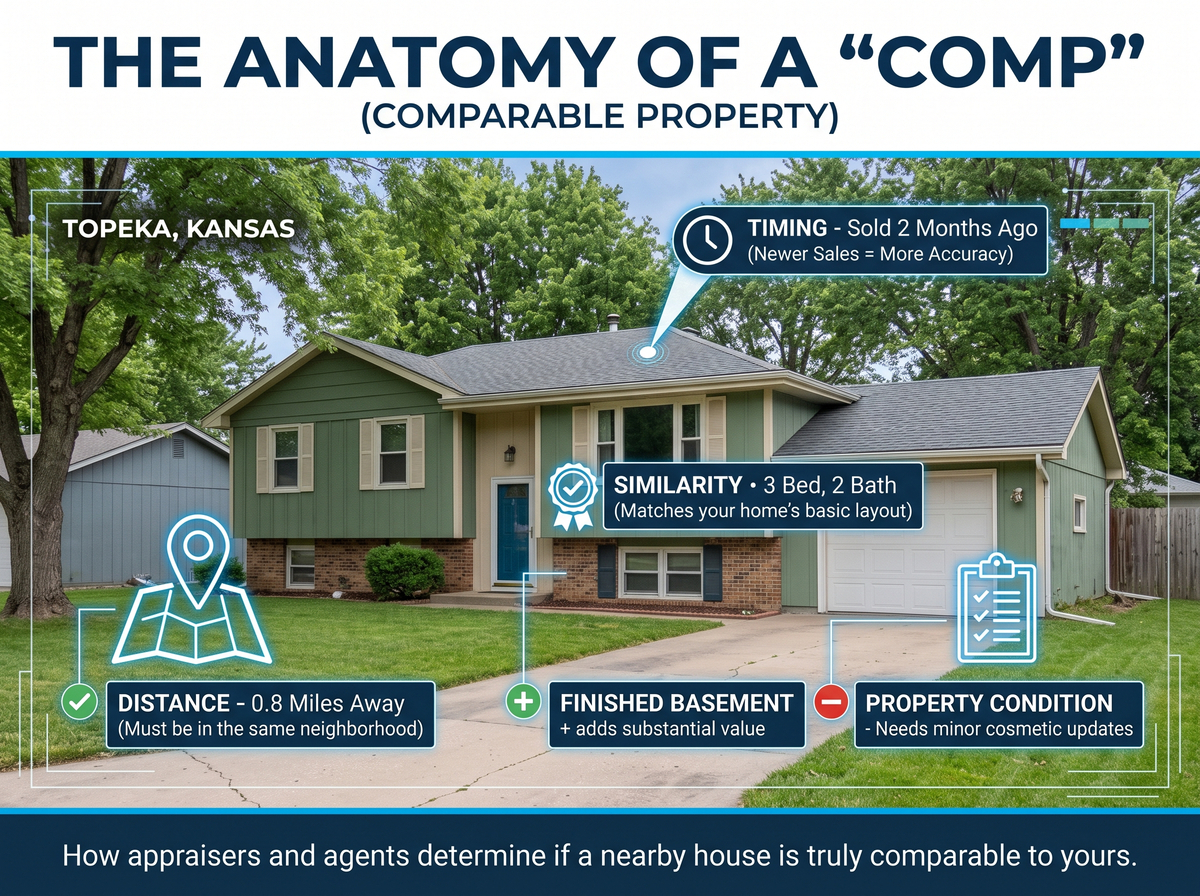
What Goes Into Your Topeka Home's Market Valuation
Short answer: a real market valuation is built from comparable properties, recent sales nearby that are similar to your home, adjusted for the differences between them and yours.
If you've ever asked an agent what your house is worth, you've probably heard them mention "comparable properties" or seen a report with a handful of nearby addresses and sale prices listed out. That report is a market valuation, and it's a lot more than just averaging a few numbers together.
Understanding how it actually works helps in two ways. It makes the number an agent hands you easier to trust, and it helps you spot the difference between a real market valuation and a rough online guess.
What a Market Valuation Actually Is
A market valuation is an estimate of what your home would likely sell for, based on what similar homes nearby have actually sold for recently.
It's not just an average of those sale prices. A good market valuation also factors in:
- Differences in condition, size, and updates between your home and each comparable property
- Homes currently for sale or under contract nearby, which shows what you're actually competing against right now
- How quickly homes in your area have been selling lately
That combination is what separates a market valuation from a simple average. It's less "what did three houses sell for" and more "what would a buyer reasonably pay for your house specifically, right now, given everything else going on nearby."
How Comparable Properties Get Picked
Not just any nearby sale counts as a comparable property. A few things narrow the list down:
- Timing. Sales from the last three to six months matter more than something that closed a year ago, especially if the market has shifted since then.
- Distance. Homes closer to yours generally count more, since location drives value even within the same part of Topeka. But distance alone isn't the whole story. A home a few streets over can sit in a completely different neighborhood than yours, with its own reputation, school assignment, or feel, even though it's close on a map.
- Similarity. Size, style, condition, and features all matter. A sale two miles away in a very different kind of neighborhood doesn't count just because the square footage happens to match, and neither does a sale right around the corner if it's really in a different neighborhood than yours.
This is also where a lot of DIY market valuations go wrong. It's easy to find a few nearby sales online. It's harder to know which ones are actually similar enough to mean anything for your home.
How to Read a Market Valuation When Someone Hands You One
If an agent gives you a market valuation, you'll usually see each comparable property listed with its actual sale price, along with adjustments up or down based on how it differs from your home.
Here's what that actually means: each comparable property's sale price gets nudged mathematically, up or down, to account for differences between it and your home. If a comparable property had an extra bathroom, its price gets adjusted down a bit before it's compared to yours. If your home has an additional garage, the comparable property's price gets adjusted up. Add up enough of these adjustments across several comparable properties, and what's left is a number that reflects what your specific home would likely sell for, not just what someone else's home actually sold for.
A few things worth knowing:
- It's normal for the adjusted number to be different from the comparable property's raw sale price. That's the adjustment working, not a mistake.
- It's normal for your estimated value to come in different from what a neighbor's house sold for, even a similar one. Condition, updates, and timing all matter.
- If a number looks off to you, it's fair to ask why a specific comparable property was included, or how a particular adjustment was calculated.
A market valuation you understand is a lot more useful than one you just take on faith.
Why You Can't Just Look This Up Yourself
In some states, actual home sale prices are public record, so anyone can look up what a specific house down the street sold for. Kansas isn't one of those states. Kansas is a non-disclosure state, which means the real sale price of a home isn't required to be recorded anywhere public.
[Internal link opportunity: Shawnee County Appraiser's public property records site, once confirmed] will show you the county's assessed value for a property, which is useful for a lot of things, but it's not the same as what the home actually sold for. Assessed values are set for tax purposes and can run higher or lower than the real sale price.
That's a big part of why a real market valuation depends on an agent's access to the MLS specifically. Agents and brokers record actual closed sale prices there as part of their membership, and that's really the only reliable source for real comparable property data in Kansas. There isn't a public workaround for it.
MLS access also brings homes currently under contract that haven't closed yet into view, the full picture of what's actively competing with your home right now, and the kind of local pattern recognition that comes from working in a specific part of Topeka every week. [Internal link opportunity: "Can You Trust Zillow or ChatGPT to Tell You What Your Topeka Home Is Worth?" post, once live]
The Most Common Mistake People Make Anyway
Even without public sale data, people still try to estimate their own value using whatever they can find, usually other homes' list prices. That's the single biggest mistake. A home can be listed at any number a seller or agent chooses. What it actually sold for is the only number that reflects what a buyer was really willing to pay, and in Kansas, that number lives in the MLS, not in anything you can pull up yourself.
A close second is leaning on an old sale from a year or more back. Even with real MLS access, if the market has shifted since then, an otherwise well chosen comparable property can point an agent in the wrong direction too.
Getting a Number You Can Actually Rely On
A market valuation is only as good as the comparable properties and local knowledge behind it. If you're seriously weighing a sale and want a real number, not a rough guess, Team Ringgold at Keller Williams One Legacy Partners puts together market valuations for sellers across Shawnee County, built from live listing data and an actual look at your home. No obligation, no pressure. Reach out here and we'll walk through it with you.
